An acceptable use policy can say which kinds of internet activity an organization permits, but the policy still needs a technical control point if those rules are going to affect network behavior.
DNS filtering is one such control point. When a client asks to resolve a domain, a policy-enforcing resolver can evaluate the name against content categories, explicit domain rules, and client context before returning an answer. That makes DNS useful for enforcing the parts of an acceptable use policy that can be expressed in terms of destinations.
DNS policy acts during name resolution
DNS filtering operates during name resolution, which usually places the decision before a new connection begins. The resolver sees a query such as www.example.com A, evaluates the name against policy, and either allows normal resolution or changes the outcome of the lookup. What it doesn’t do is reach backward. A newly applied rule doesn’t terminate connections that already exist, and it isn’t evaluated when a client answers from its own cache or connects without a fresh DNS query, because nothing reaches the policy resolver.
That position gives DNS filtering broad reach. Browsers, mobile apps, desktop software, streaming clients, game launchers, and many other applications rely on DNS before connecting to named internet services. When those applications use the policy-enforcing resolver, the same domain policy can apply without inspecting their application traffic.
The resolver is still making a DNS decision. It isn’t reading the web page, parsing the full URL, or deciding whether a particular piece of content on the destination is acceptable.
Categories turn broad policy rules into resolver decisions
Maintaining individual domain rules doesn’t scale well when an acceptable use policy covers broad classes of destinations. DNS filtering systems commonly solve this by associating domains with categories and letting policy refer to those categories.
An organization might restrict categories associated with adult content, gambling, games, streaming media, social networking, file sharing, or anonymization services. The exact categories and their definitions vary by filtering system. DNS itself defines no content taxonomy and carries no record that says a domain belongs to a particular category.
The category is metadata supplied by the filtering system or an external classification source. The resolver uses that metadata as an input to its policy decision.
Domain rules handle exceptions and local requirements
Category rules provide breadth, while explicit domain rules provide precision at the name level.
A school might restrict a broad streaming category but permit a video platform used for coursework. A business might allow a social networking category for one department while denying a specific domain that violates an internal policy. Another environment might deny a domain regardless of its assigned category because of a legal, contractual, or local operational requirement.
These decisions depend on the policy engine. Precedence between categories, allow rules, deny rules, and inherited policies isn’t standardized by DNS, so two filtering systems may resolve the same policy conflict differently.
The same domain can receive different policy decisions
Many deployments need more than one acceptable use policy. Employees, students, guests, contractors, managed devices, and specialized networks may have different requirements.
A filtering system can make different decisions for the same queried name when it has reliable context about the source of the query. Depending on the architecture, that context may be associated with a source network, device, authenticated user, directory group, or another identity signal.
DNS defines no general-purpose field for an enterprise user identity or an acceptable use policy name. Extensions can carry adjacent signals, such as a client network prefix in an EDNS Client Subnet option, but nothing standard says which person or policy a query belongs to. The filtering architecture has to derive that context, from the query source, transport metadata, an authenticated agent or session, or an out-of-band mapping, before the resolver can apply a differentiated policy.
DNS filtering controls destinations at hostname granularity
The natural enforcement boundary is the domain name being resolved.
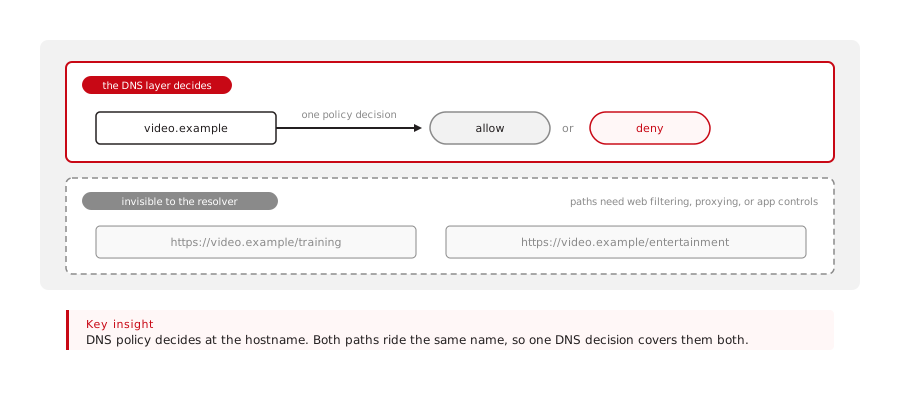
If video.example hosts an entire service, a DNS policy can allow or deny resolution for that hostname. If both permitted and restricted material are served from the same hostname, DNS has no visibility into which page, account, channel, file, or URL path the user intends to access.
For example, DNS can make a decision about:
video.exampleIt normally can’t make separate decisions about:
https://video.example/training
https://video.example/entertainment
Both URLs depend on the same hostname. Controls that need path-level or content-level decisions operate above DNS, such as URL-aware web filtering, a secure web gateway or proxy, or application controls.
Shared platforms create the same problem at a larger scale. Blocking a hostname used by many unrelated tenants can affect legitimate services along with the restricted destination. More specific subdomains help only when the service exposes those tenants through distinct DNS names.
Resolver control determines whether the policy is reached
A DNS policy only applies to queries that reach the resolver enforcing it.
An endpoint that sends queries to a different recursive resolver may receive an answer without the organization’s category or domain policy being evaluated. Encrypted DNS changes the transport but not that basic rule. DNS over HTTPS, DNS over TLS, and DNS over QUIC can all carry queries to a policy-enforcing resolver, or to a different resolver that has no knowledge of the organization’s policy.
This makes resolver selection part of the enforcement architecture. Networks and managed endpoints that depend on DNS policy need a way to keep applications and devices using an authorized resolution path.
DNS logs record resolution activity
Protective DNS can also produce query, response, and policy-decision data that helps operators understand how an acceptable use policy is being applied. A blocked query can show that a client attempted to resolve a restricted domain and which rule caused the decision.
A DNS query doesn’t prove that a person intentionally visited a site. Applications generate background queries, pages load third-party domains, software performs prefetching, and operating systems resolve names without direct user action.
DNS telemetry is therefore useful for policy operations and investigation, but it should be read as evidence of resolution activity rather than a complete record of user behavior.
Summary
DNS filtering gives acceptable use policies an enforcement point at name resolution. Category rules make broad restrictions manageable, explicit domain rules provide local exceptions, and client context can support different policies for different populations when the deployment architecture provides that context.
The control remains bounded by DNS. It works with names and resolver decisions, not page content or full URLs. That boundary is what makes DNS filtering broadly deployable, and it’s also what determines which parts of an acceptable use policy need another enforcement layer.