What problem does DNS solve?
Computers communicate using numerical addresses, but humans don’t.
Every system on an IP network needs an address so other systems can send it traffic. Addresses are efficient for routing packets, but they are hard to remember, and they change as infrastructure evolves. The earliest networks handled naming with a shared text file listing every host on the network, an approach that stopped working once the network grew past a few hundred machines.
The Domain Name System separates naming from addressing. People and applications rely on stable, human-readable names such as example.com, while the network destinations behind those names change freely. Servers move, scale, and fail without users tracking any of it.
Every DNS lookup is that separation at work. Given this name, what network information should be used right now?
Where DNS stops
DNS answers questions about names. It carries no application data, no web pages, no email, and no connections. Its work ends the moment it has told another protocol where to connect. From there the conversation continues over TCP, HTTP, SMTP, or whatever the application speaks, and DNS stays out of it until the next lookup.
Because almost every network interaction starts with a lookup, DNS failures are unusually visible. When resolution fails, applications look unreachable even when the network underneath is healthy. A large share of “the internet is down” reports are really name resolution failing.
DNS and the network stack
DNS is usually filed under the application layer, since it defines its own message format and rules of behavior. But it exists to serve other applications rather than deliver content, and its messages ride on ordinary transport, historically UDP and TCP on port 53. That in-between position explains a familiar troubleshooting pattern where the browser reports an error, the network checks out fine, and the culprit sits in the middle.
DNS as a distributed, hierarchical system
No single database holds every name on the internet. DNS divides the namespace into a hierarchy, and each layer knows only how to direct queries to the next.
The root servers sit at the top. They store no records for individual domains. Their job is to point resolvers at the servers for each top-level domain, such as .com or .org. The TLD servers in turn know which authoritative servers are responsible for a given domain like example.com. Only those authoritative servers hold the records that answer questions about the domain.
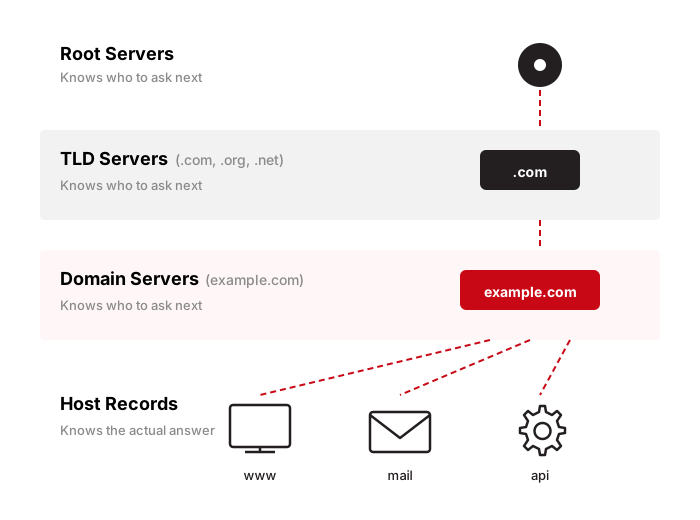
The root itself is small, with thirteen named server identities operated by twelve independent organizations and replicated across hundreds of physical locations worldwide. Delegation is what lets a design from the 1980s carry today’s internet without a central point of control.
Separation of authority and resolution
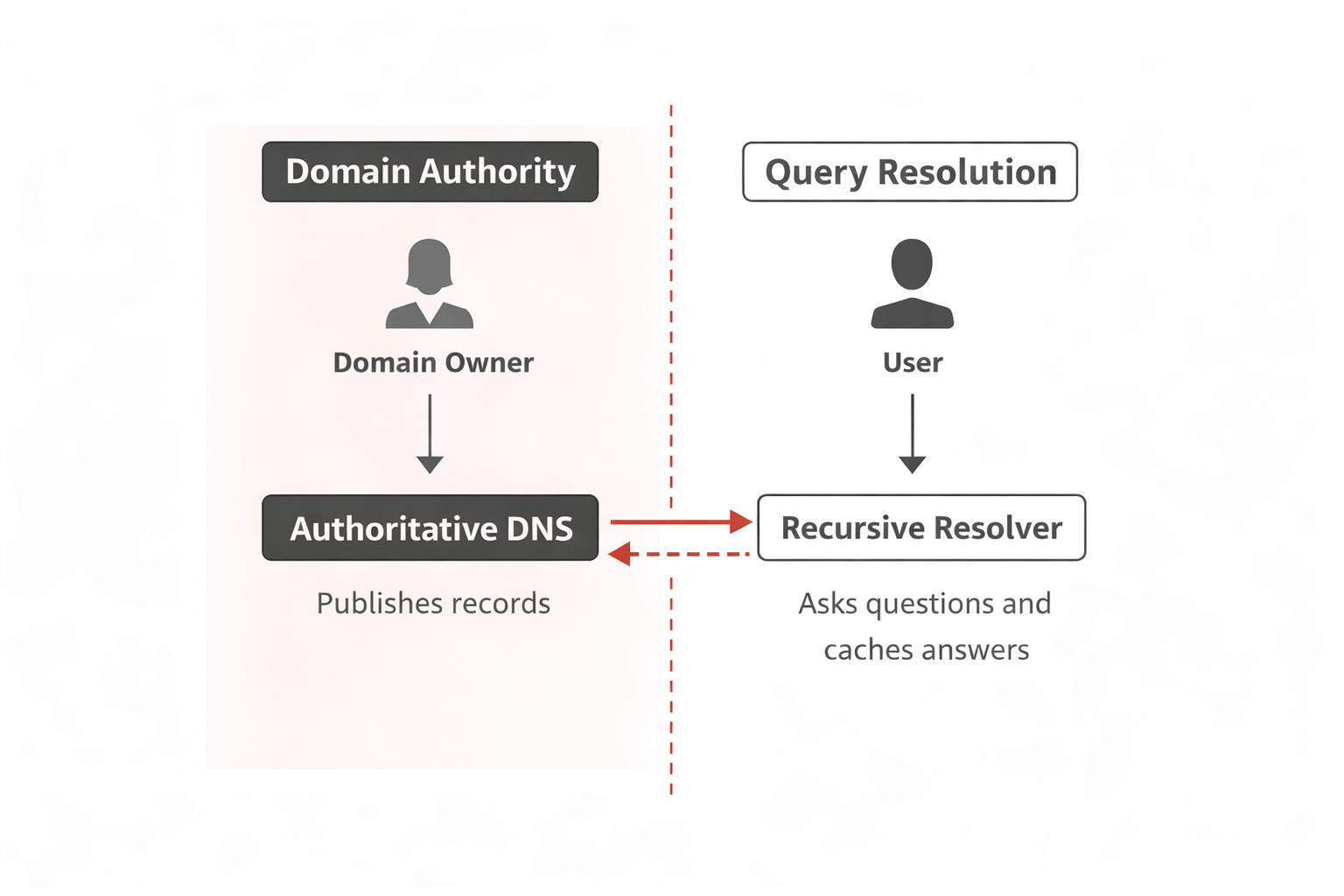
Two distinct roles share the work of DNS, and they are run by different people.
Authoritative servers are operated by or for domain owners. They publish the records for their own zones and answer for nothing else, and they don’t chase down answers for unrelated domains.
Recursive resolvers work the other side. They answer lookups on behalf of users and applications, walk the hierarchy when they have to, and cache what they learn so the next asker gets an instant answer.
A resolver owns none of the data it serves, and an authoritative server never needs a view of the full DNS namespace. Your ISP’s resolver, a public resolver such as 1.1.1.1 or 8.8.8.8, and the authoritative servers for example.com are independent systems that cooperate through nothing more than a shared protocol.
Why DNS is designed this way
DNS was designed in the early 1980s for networks that were smaller, slower, and far less reliable than today’s.
Bandwidth constraints favored compact messages, latency made caching essential, and central coordination had already failed once.
The result is a system built on delegation, aggressive reuse of cached answers, and eventual consistency instead of global synchronization. Modern networks look nothing like 1983, but the structure survives because it still scales.
What this means in practice
DNS resolution on a real network is cooperation among systems run by different organizations, each holding partial information, most of it cached.
Changes to DNS data therefore don’t appear everywhere at once. DNS trades instant consistency for scale and fault tolerance by design.
The same authoritative data can produce different behavior on different networks at the same moment. What looks like “DNS propagation” is caches expiring on their own schedules.
Summary
DNS is a distributed, hierarchical directory that maps human-readable names to machine-usable network information, and its involvement ends at the answer. It carries no traffic, guarantees no availability, and vouches for nothing it returns.
Those properties were chosen deliberately, so the system could scale and tolerate failure without sitting under any single party’s control.