The dots in a domain name suggest a simple text string, and most people treat names that way. DNS doesn’t. Under the hood a name is a structured sequence of labels in a global tree, and that structure, not the string, determines how delegation, caching, and control behave.
The gap between those two views is where operational surprises come from: changes that affect more names than intended, delegations that hand over more than expected, and behavior that looks arbitrary until you see the boundaries DNS actually honors.
A name is a sequence of labels
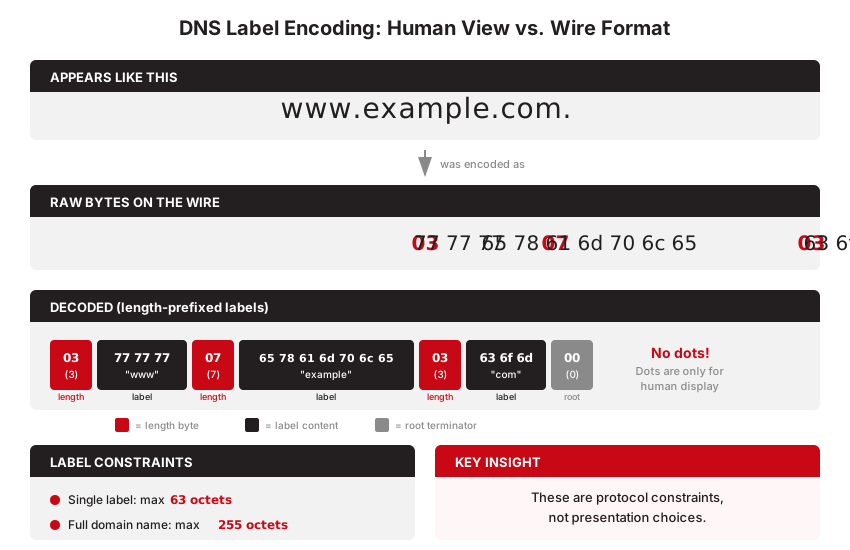
Read www.example.com. from right to left: the root (that usually invisible trailing dot), then com, then example, then www. Each dot-separated piece is a label, and the sequence runs from the root down to the most specific label at the left edge.
User interfaces almost always omit the trailing dot, but it’s always present conceptually. Every fully qualified name ends at the root. Resolution depends on this shape. A resolver with nothing cached walks from the root downward, following delegation at label boundaries until it reaches an authoritative answer.
Label rules come from the protocol
Labels are the atomic unit of DNS naming, and the protocol constrains them precisely. A label may not exceed 63 octets. A complete name may not exceed 255 octets in its wire representation. Comparisons are case-insensitive for resolution. These are message-format limits, not conventions, and they hold on every platform.
The dots, on the other hand, are pure presentation. On the wire, DNS transmits each label prefixed by its length and ends the name with a zero-length label for the root. www.example.com. travels as [3]www[7]example[3]com[0], and no dot appears anywhere in the encoding. Dotted strings exist only at presentation boundaries such as configuration files and diagnostic tools.
The namespace is a tree
The namespace is a tree with the root at the top, top-level domains beneath it, and further branches wherever domain owners create them. Every node is a potential delegation point, and authority changes hands only at label boundaries.
That’s the entire scaling model. Each delegation is agreed between a parent and a child, no central registry manages the whole tree, and names stay globally unique anyway.
Domain names versus zones
A domain name marks a position in the tree. A zone marks an administrative boundary. The two only sometimes coincide. Zones exist where authority is delegated, and most names are simply entries inside someone else’s zone. example.com may be a zone, while www.example.com is usually just a record within it.
Authoritative answers are always served from zones, never from abstract positions in the tree. That’s why some DNS changes are a quick edit in your own zone while others require coordinating with a registrar or another operator.
Why labels matter operationally
Because DNS operates on labels rather than strings, label structure decides where control lives. Delegation happens only at label boundaries. Caching operates per name and record type. DNSSEC validation follows the chain of trust across delegations. Filtering, logging, and access-control policy attach to specific levels of the hierarchy.
Partition a name carelessly and the consequences reach further than intended:
That delegation transfers authority for the entire subtree. The provider's servers now answer not only for api.example.com but for v1.api.example.com, internal.api.example.com, test.staging.api.example.com, and anything else beneath it.
If the organization later wants internal.api.example.com back for its own infrastructure, no single record edit will do it. It must remove the delegation entirely or rely on the provider to delegate that subtree back. DNS follows the namespace hierarchy, not organizational boundaries or intent.
Internationalized domain names
DNS never processes Unicode. Applications convert names containing non-ASCII characters to an ASCII-compatible form before the query is sent, using Punycode: bücher.example becomes xn--bcher-kva.example, and at the protocol level the encoded label is just another ASCII label under the usual length and encoding rules.
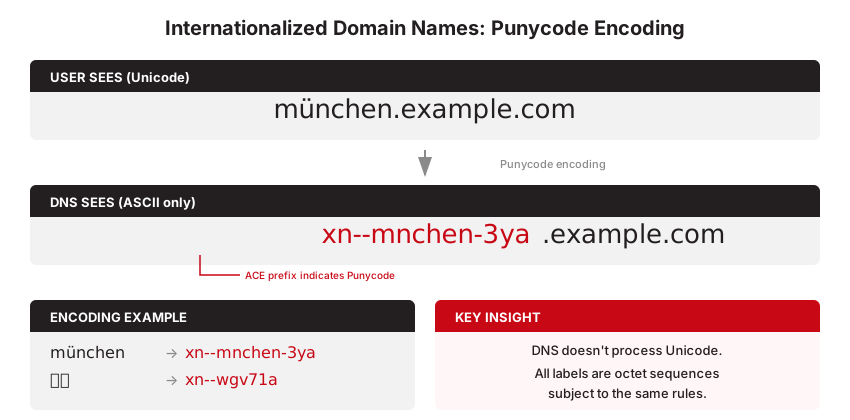
The conversion has a security edge. Visually confusable characters can let attackers register lookalike names that render almost identically to trusted ones, one of several reasons DNS draws so much attacker attention.
Summary
A domain name is a path through a tree, not a string with dots in it. Delegation, caching, DNSSEC, and policy all follow the label structure, so when DNS behavior surprises you, look there first: where delegation occurs, what lies inside which zone, and which servers are authoritative for that part of the namespace.