DNS is usually introduced as a simple lookup system: a client asks, a server answers, caches make the next ask faster. The model is accurate. It’s also incomplete.
Once DNS infrastructure grows past a single server or a single network, other forces take over. Latency varies by geography. Load arrives in bursts, not averages. Failures stop being rare events and become a permanent background condition. Large DNS systems are designed around those three realities, latency, load, and failure domains, far more than around raw throughput.
Latency becomes a structural constraint
At small scale, DNS latency is typically dominated by the local network. The resolver is nearby, authoritative servers are a few hops away, and response times are predictable.
At large scale, physical distance asserts itself. Queries cross continents, run under oceans, and follow routing decisions that were never optimized for DNS in particular. Small differences in path selection change how long an answer takes.
Anycast reduces perceived latency by letting many servers share one IP address, with the network delivering each query to whatever it considers the closest instance. That helps, but “closest” is a routing judgment, not a geographic one, and it can change with routing updates or failures elsewhere on the internet.
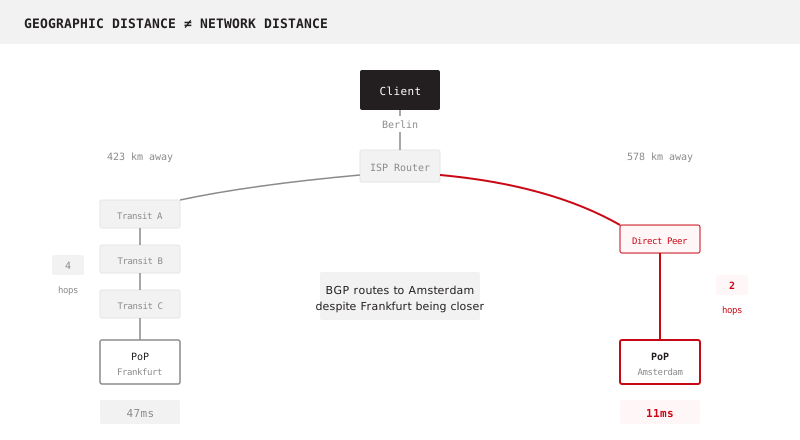
Caching hides most of this, most of the time. A cache hit skips the upstream lookups entirely, while a miss or expiry pays the full latency price again. At scale those misses are unavoidable, and they’re often synchronized across many clients at once.
Load arrives in bursts
DNS load gets quoted in queries per second, but averages mislead. Real traffic is spiky, driven by user behavior, application restarts, cache expiration, and external events.
A single popular record expiring can send a crowd of resolvers back to the source at nearly the same moment. Negative caching suppresses load for names that don’t exist, right up until it expires and those queries return just as abruptly.
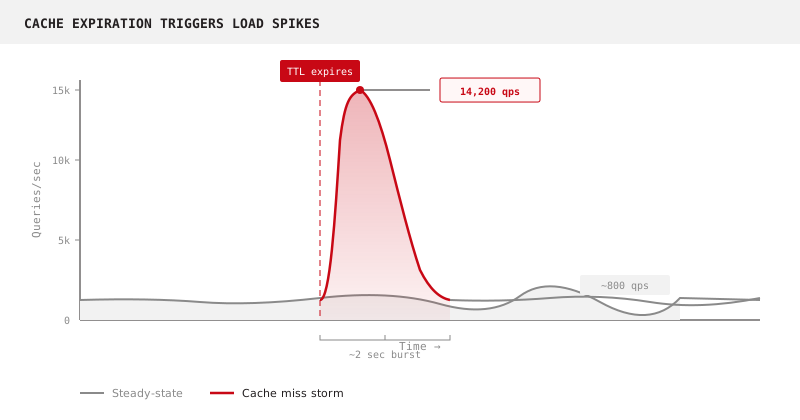
Retries amplify everything. A resolver that gets no timely answer asks again, often against multiple servers, so one logical question lands as several packets of demand. DNS systems are therefore sized for worst-case bursts, not steady state.
Failure domains are intentional
At internet scale, failures are normal. Links flap, servers crash, power goes out, routes change. Large DNS systems assume some part of the system is always degraded.
A failure domain is the boundary a failure can spread within. DNS infrastructure is deliberately segmented so that boundary stays small: individual servers, anycast points of presence, regions, or entire upstream networks, each meant to keep a failure from dragging down the rest.
Resolvers meet the infrastructure halfway. They query multiple authoritative servers, follow delegation chains, and retry another listed server when one option dies. This is why DNS so often looks resilient while pieces of it are actively broken.
The price of contained failure is inconsistency. During an incident, different users legitimately see different answers and different response times, because caches and fallback behavior differ across paths, and that is the design working.
Partial failure is the steady state
Systems are supposed to be healthy or down. At scale, DNS lives between those states permanently. Some queries fail while others succeed, and some regions degrade while others hum along.
This isn’t a flaw. It’s what designing for availability across unreliable networks produces. DNS trades strict consistency for availability through TTL-based caching, and it accepts a blurry middle as the cost.
That model explains the behaviors that surprise operators most: intermittent resolution failures, latency reports that disagree with each other, and monitoring that swears everything is fine while users disagree.
Why this matters operationally
Latency, load, and failure domains shape nearly every operational decision in large DNS systems. TTL values set both cache behavior and spike size, which is why DNS changes get planned around them. Anycast placement decides who feels a routing change. Redundancy choices decide how far a failure travels.
Treat DNS as a simple lookup service and you get fragile designs. Treat it as a distributed system operating under constant partial failure and you get realistic expectations and infrastructure that survives contact with the real world.
Summary
At scale, DNS is governed less by protocol mechanics than by physical distance, bursty demand, and routine failure. Large DNS systems succeed by hiding those realities most of the time and containing them when they surface. Operating DNS reliably starts with accepting that partial failure is the normal condition, and designing so users rarely notice.